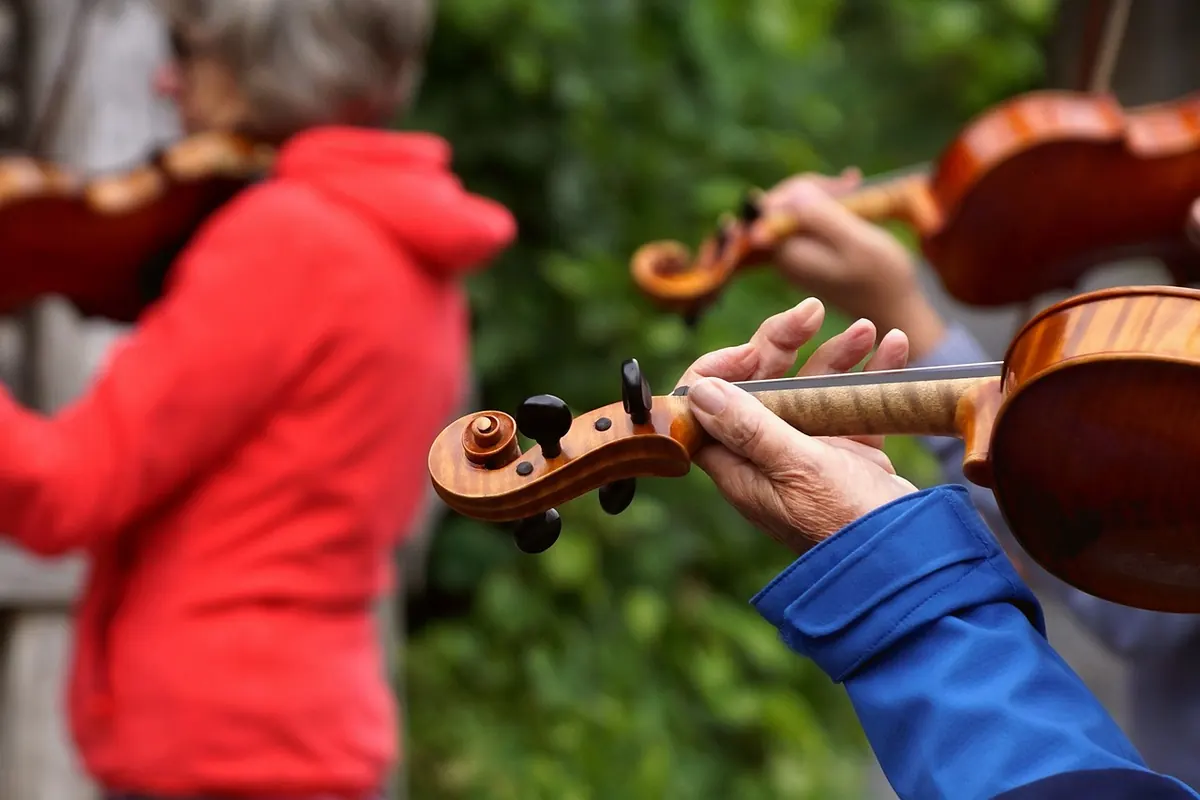
The hall doors usually open about half an hour before the first tune, and by the time the circle is full there is a folding table of cake near the radiator and someone tuning an instrument that has been in the same family for forty years. Nobody announces a start. The music begins when the player who has chosen the first tune nods at the others, and everyone else falls in behind.
These monthly evenings are not concerts, and that distinction is the whole key to enjoying one. There is no stage, no set list, no interval bell. A group of musicians sits in a loose ring, plays tunes together, and between tunes someone sings a song or explains where the last one came from. Listeners sit in the outer ring, drink tea, and go home humming something they cannot name.
If you have seen the notice on the shop door and wondered whether you would be welcome, this is for you. It covers how the night runs, what to do with your hands during a song, and how to join in if you play or sing — even badly, even for the first time.
Forget the word "folk" if it makes you picture a stage. The music here is mostly dance tunes — waltzes, mazurkas, polkas, the occasional slow air — plus songs in dialect and in English, sung unaccompanied or with a guitar. Tunes arrive in sets of two or three, played three or four times through, so you can hear the shape of them before they change.
The volume is modest. There is no amplification, which means the room has to do the work: everyone plays a little softer than they would at home, and the melody passes around the circle instead of sitting with one person. You will hear mistakes. Someone will lose their place and come back in two bars later, and nobody will look up. That is not sloppiness; it is the ordinary sound of people playing together without rehearsal.
Expect roughly the same faces each month — a core of five or six players, a handful of regular listeners, and two or three newcomers who heard about it from a neighbour. Expect the repertoire to repeat, too. A small valley has a small tune book, and much of the pleasure is hearing the same waltz played better in March than it was in January.
None of this is fixed. On a cold night in February the break may come early; in summer, when the session moves into a garden or a barn, the whole thing drifts. Treat the order as a habit rather than a programme.
Regulars will tell you there are no rules, which is not quite true. There are about six, and they all come down to not becoming the loudest thing in the room.
Children are welcome and usually end up dancing at the back, which everyone enjoys until about nine o'clock. Bring something to keep them quiet and sit near an exit. If you are staying in the valley for a week, come anyway; nobody checks your address, and a good half of the regulars started out as guests.
The short version: turn up, say hello, and listen to a whole set before you open a case.
The longer version is worth knowing. Players tend to invite by gesture — a nod, a lift of the chin towards an empty chair, a quiet "do you play?" at the break. Sit in the outer ring first with your instrument visible; that is usually signal enough. When you do join, sit beside someone playing the same kind of thing, so you can watch their hands.
Two habits make a newcomer welcome. Play softly until you know where the tune is going; nobody minds a quiet player finding their feet, and everybody notices a loud one who is not. And learn two tunes properly rather than twenty approximately. The repertoire is not large, and someone who can hold a steady rhythm on the four most common tunes will be asked back.
If you sing rather than play, the etiquette shifts slightly. Songs are usually unaccompanied, in whatever key suits your voice, and a song with a story in it does better than a song with a big finish. Mention at the break that you have one, and you will be given a turn.
Check the noticeboard or the village page for the date, since a few sessions shift around holidays and harvest. Arrive early if you want to talk, on time if you would rather slip in quietly. Bring a friend, bring a cup, bring cake if you have been meaning to for months. Ask your questions at the break rather than during a song. And if you play, bring the instrument — the worst that happens is you sit on the outer ring with it on your knee and listen, which is a perfectly good way to spend an evening.
The session is not a performance and not an audition. It is a room, a circle and roughly two hours of music that exists because a dozen people carried chairs out of a cupboard. Come once and you will hear the tunes again all month; come twice and somebody will learn your name.
Photo: suju-foto / Pixabay
Pricing by instinct, invisible signs and a cash-only tin cost new stallholders more than they realise. Practical...

A practical comparison of the weekly market and the village shop — on price, freshness, opening hours and selection...

A practical listening guide to the dialect phrases echoing around the valley's market stalls, with pronunciation...

Local news and stories from the valley.
